
Left to Tell: Discovering God Amidst The Rwandan Holocaust by Immaculee Ilibagiza and Steve Erwin: A Book Review
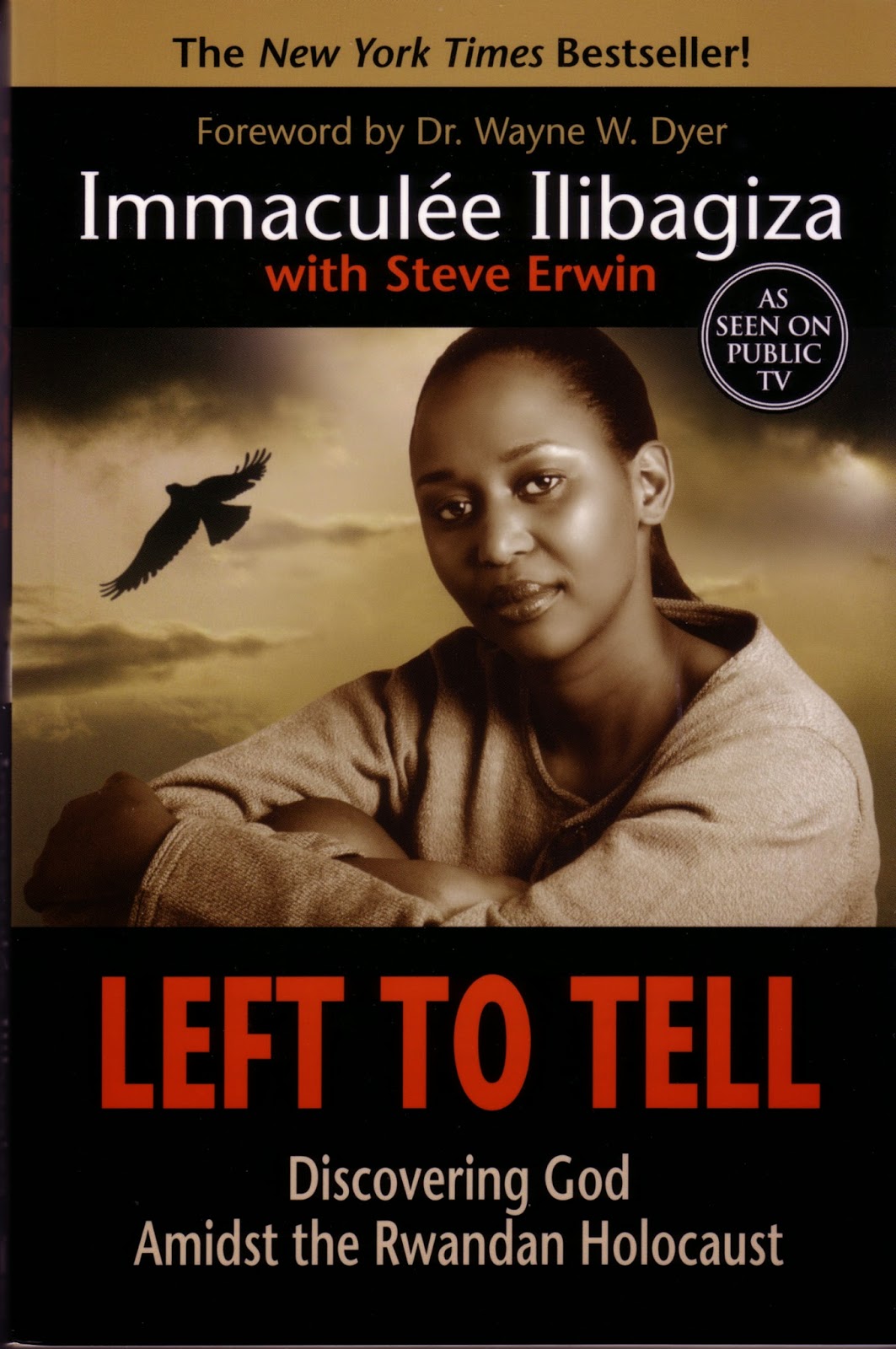 Left to Tell: Discovering God Amidst The Rwandan Holocaust
 Author: Immaculee Ilibagiza and Steve Erwin
Genre: Nonfiction, Autobiography & Memoir, History, Christian
Publisher: Hay House
Release Date: 2007
Pages: 215
Source: Personal Collection
Synopsis: Immaculee Ilibagiza grew up in a country she loved, surrounded by a family she cherished. But in 1994 her idyllic world was ripped apart as Rwanda descended into a bloody genocide. Immaculee’s family was brutally murdered during a killing spree that lasted three months and claimed the lives of nearly a million Rwandans.
Incredibly, Immaculee survived the slaughter. For 91 days, she and seven other women huddled silently together in the cramped bathroom of a local pastor while hundreds of machete-wielding killers hunted for them.
It was during those endless hours of unspeakable terror that Immaculee discovered the power of prayer, eventually shedding her fear of death and forging a profound and lasting relationship with God. She emerged from her bathroom hideout having discovered the meaning of truly unconditional love—a love so strong she was able seek out and forgive her family’s killers.
The triumphant story of this remarkable young woman’s journey through the darkness of genocide will inspire anyone whose life has been touched by fear, suffering, and loss.
My Review: Immaculee Ilibagiza’s Left to Tell tells her story of survival and of her relentless faith in God during the Rwandan genocide in 1994. She survives by hiding in a tiny hidden bathroom with seven other women and young girls at a local pastor’s house for 91 days. The only concealment she has from being found out is a bookshelf that covers the bathroom door. During this time of terror, Immaculee finds peace, comfort, and hope of God’s boundless love. Immaculee believes that she will survive the genocide because of her faith in God, and begins to start planning for her future.
In the beginning of the memoir, Immaculee came from a loving family with father, mother, and three brothers. Her parents raised them up without the knowledge of the discrimination of the different races. They believed that everyone in Rwanda were equal and that everyone was their brother and sister. However in fourth grade, Immaculee realizes the racial conflicts between the Tutsis and the Hutus, when her teacher called rolled by their races, and Immaculee didn’t know which race she was. She also found out that she was having a tough time getting into high school and college because she was a Tutsi.
However, Immaculee experienced bloodshed, violence, and hatred when in her freshman year in college she came home for Easter vacation. There the genocide of Rwanda had begun. The Hutu army wanted to exterminate the Tutsis. Because Immaculee’s father was in a position of power and authority, he tried to make peace with the Hutus, but didn’t succeed. Hundreds of Tutsis came to Immaculee's yard for protection of the genocide. However, even though Immaculee's father and the Tutsis tried to defend themselves against the Hutus, they knew that they would not succeed.
In order to protect his family, Immaculee's father sent Immaculee, her two brothers, (one of her brother was in college out of the country) and her brother’s Hutu friend, who was staying with them for the holidays, to stay with a local Hutu pastor. When they got there, the pastor was left with a difficult choice. He could only protect women. He sent her brothers and her brother’s friend out of the house and told them to seek asylum elsewhere. Her parents, two brothers and brother’s friend would later be killed by the Hutus. Immaculee and seven other women and young girls hid in a bathroom with only a shower stall and toilet, and there was no place for a sink because of the small size. There they stayed, while many times the Hutus would come into the house looking for them, and they were afraid. Sometimes it was so risky that the pastor could not even bring food and water, and many times they were starving and dehydrated. They couldn’t move a muscle.
During this time of fear and terror, Immaculee clutched to God. She was a Roman Catholic, and would pray the rosary. Sometimes she asked the pastor to bring a bible. Her prayers gave her peace. She then contemplated God’s word, and decided to forgive the Hutus for the genocide. She also started to plan for her future by trying to learn English from an English dictionary her pastor gave her.
Overall, I felt this memoir to be an important book about faith and the love of God. It is through her hope and God’s infinite love that she found peace in a troubled time. It was her faith in God that helped her survive the Holocaust. The memoir is thought-provoking and teaches us to forgive even people who have done us wrong. I encourage you to read this book for it will be a hopeful message of God’s love, and that where there is darkness, there is also hope.
Rating: 5 out of 5 stars
This is an interview with CBS News as she talks about her book and her story of survival and forgiveness:
I have not read 'Left to Tell', but your review left me thinking that it could be an interesting book to read. I will definitely try to get hold of it. Too often tragedies have no names - just numbers. When the tragedy focusses on people (with names), it is then that the true impact of the horror and the injustice really comes home to us.
ReplyDeleteIt is an awesome read. She actually came to my college and told us her story. This book does recount the tragedies of the Holocaust, but it also focuses on hope.
ReplyDeleteshe is coming to my highschool next year can't wait!!!
ReplyDeleteI just finished reading this book Left To Tell. Jesus Christ, what a journey through the valley of death!
ReplyDeleteI am completely speechless. I have been looking for sleep.
Dear Immaculée God bless you and your family. Your forgiving heart is from the heart Jesus Christ.
But please write another edition and include visiting the Pastor who risked his life and hid you and your compatriots.
God bless the Pastor and his family.
I must always have this book with me.
Thank you.
Rev. Livinus Cmf
Nigeria.