
Blog Tour: Guest Post by Shelley Stratton: Trolley Cars, the Metro, and Bringing Historical Settings to Life
Shelly Stratton is the author of She Wears the Mask. This interesting guest post discusses how she incorporates realistic details and facts about streetcars from the early 20th century, which were common long before her birth. Mrs. Stratton describes her love of these older modes of public transportation as well as how she felt a joy and kinship with those who patronized these iconic symbols of urban transportation throughout the industrial age. Thank you, Mrs. Stratton!

Decades ago, whenever I visited my great grandmother and great aunt in NW Washington, D.C., they would always ask me, “Did you drive in or take the trolley car here?” As I removed my coat or stowed away my umbrella, I would politely correct them with “I took the metro.” But after correcting them so many times and both of them persistently referring to the metropolitan transit train system as the “trolley car,” I gave up.
I realized that the trolley or streetcars, which had arrived in D.C. as far back as 1862 and weren’t discontinued until the 1960s, had been around much longer than the metro train system I rode every day. Therefore, it occupied a lot more of their collective memories. In my great grandmother’s and great aunt’s minds, the metro hadn’t logged enough years to be worthy of being remembered by its own name yet, I assume.
Like many other major U.S. cities, streetcars were once plentiful in D.C., with trolley tracks and overhead wires traversing numerous streets and local neighborhoods. People rode the street cars to work, back home at the end of the day, to department stores downtown with the family on weekends and to neighboring counties in Virginia and Maryland. Streetcars were egalitarian in some ways. (Both the poor, middle class, and wealthy could ride them and did so regularly.) And it was not so egalitarian in other ways. (My grandfather told me that when he rode the streetcar in D.C. as a teenager, he could sit wherever he wanted, but as soon as the car passed the state line into Maryland, he had to move to the “Colored” section in the back, freeing his seat for the white patrons who boarded.)
In D.C. and other cities throughout the country, streetcars were part of the historic fabric of city life and characters onto themselves, bearing witness to many major events and the evolution of the urban landscape. This is why I knew I had to include them in my novel, She Wears the Mask.
For example, in May 1950, a Chicago Transit Authority streetcar collided with a delivery truck carrying 8,000 gallons of gasoline. The resulting explosion killed 34 people and injured 50 others. It would become known as the Green Hornet Streetcar Disaster and remains one of the deadliest public transit disasters in Chicago history. With a book set partially during this era in Chicago, I couldn’t resist working such a pivotal moment in Chicago past’s into the story to introduce a hint of realism to the text, which I think can be a strength in any historical fiction work. So I decided to have one of the main characters, Angelique, lose her husband in the Green Hornet Streetcar Disaster, forever changing the course of her life and impacting the decisions she makes for decades to come.
But that realism couldn’t just stop at reciting historical facts. I wanted to show what it was like to be there, to board and ride on those streetcars every day. That’s the level of minutia I look for in a good book. But I was at a disadvantage; born in the 1980s, I grew up in D.C. long after our streetcars had disappeared. I had no idea what it was like to ride one. How did streetcar operators dress? How many seats per car? What did the cars sound like? I couldn’t ask my relatives; they had died many years before.
So I not only searched old newspapers, but also examined pictures and maps showing streetcar routes in Chicago and other cities. I even watched YouTube videos with patrons describing what it was like to ride these streetcars, recounting everything from how much they paid to board to what the streetcar whistle sounded like. It was the kind of deep dive that some might consider boring, but I found it fascinating. It helped me to understand the time and place of the characters and even if I didn’t provide all these sensory details in the text itself, it helped me to see what was happening. I hope made the novel even more vivid.
Shelly Stratton is the penname of an award-nominated author who has published three books and more than a dozen books under another pseudonym. She is married and lives in Maryland with her husband and their daughter. Her latest book, She Wears the Mask, is a work of historical women’s fiction. Visit her at her web site www.shellystrattonbooks.com to learn more about her work.


Synopsis: No one can ever really know what lies behind the mask . . .
Gripping and moving, She Wears the Mask is a novel about two women from two very different worlds, both burdened with secrets from their pasts, who form an unexpected bond…
1950s Chicago: Angelique Bixby could be one of many fresh-faced sales girls working along the Magnificent Mile, but she’s unique. She’s a white woman married to a black man in 1950s Chicago, making her stand out among the tenements on the South Side where she lives. Despite the challenges the couple faces, they find comfort and strength in their love for one another. Angelique is content, as long as she has her Daniel by her side and their baby in her arms, until she loses them both—one to death and the other to dire circumstances.
1990s Washington, D.C.: Angelique Crofton is a woman of privilege. A rich, aging beauty and mother of a rising political star, she has learned to forget her tragic past. But now that she is facing her own mortality, she is finally ready to find the daughter she left behind, remember the young woman she once was, and unearth the bittersweet memories she had long ago buried.
Jasmine Stanley is an ambitious lawyer—the only black woman at her firm. She is too busy climbing the corporate ladder to deal with her troublesome family or their unresolved issues. Tasked with Angelique’s case, Jasmine doesn’t know what to make of her new client—an old debutante with seemingly too much time and money on her hands. Jasmine eagerly accepts the challenge though, hoping if she finds Angelique’s long-lost daughter, it will impress the firm’s partners. But she doesn’t count on the search challenging her mentally and emotionally. Nor does she expect to form a friendship with Angelique, who is much more like her than she realizes—because Jasmine is harboring secrets, too.
Monday, August 17
Review at Books, Writings, and More
Tuesday, August 18
Feature at I'm All About Books
Wednesday, August 19
Interview at Chicks, Rogues, and Scandals
Thursday, August 20
Review at 100 Pages a Day
Friday, August 21
Review at Gwendalyn's Books
Monday, August 24
Review & Excerpt at Robin Loves Reading
Tuesday, August 25
Interview at Bookish Rantings
Excerpt at The Caffeinated Bibliophile
Wednesday, August 26
Feature at Reading is My Remedy
Thursday, August 27
Review at Passages to the Past
Friday, August 28
Guest Post at History from a Woman’s Perspective
Monday, August 31
Interview at Jorie Loves a Story
She Wears the Mask

Trolley Cars, the Metro, and Bringing Historical Settings to Life
By Shelly Stratton
Decades ago, whenever I visited my great grandmother and great aunt in NW Washington, D.C., they would always ask me, “Did you drive in or take the trolley car here?” As I removed my coat or stowed away my umbrella, I would politely correct them with “I took the metro.” But after correcting them so many times and both of them persistently referring to the metropolitan transit train system as the “trolley car,” I gave up.
I realized that the trolley or streetcars, which had arrived in D.C. as far back as 1862 and weren’t discontinued until the 1960s, had been around much longer than the metro train system I rode every day. Therefore, it occupied a lot more of their collective memories. In my great grandmother’s and great aunt’s minds, the metro hadn’t logged enough years to be worthy of being remembered by its own name yet, I assume.
Like many other major U.S. cities, streetcars were once plentiful in D.C., with trolley tracks and overhead wires traversing numerous streets and local neighborhoods. People rode the street cars to work, back home at the end of the day, to department stores downtown with the family on weekends and to neighboring counties in Virginia and Maryland. Streetcars were egalitarian in some ways. (Both the poor, middle class, and wealthy could ride them and did so regularly.) And it was not so egalitarian in other ways. (My grandfather told me that when he rode the streetcar in D.C. as a teenager, he could sit wherever he wanted, but as soon as the car passed the state line into Maryland, he had to move to the “Colored” section in the back, freeing his seat for the white patrons who boarded.)
In D.C. and other cities throughout the country, streetcars were part of the historic fabric of city life and characters onto themselves, bearing witness to many major events and the evolution of the urban landscape. This is why I knew I had to include them in my novel, She Wears the Mask.
For example, in May 1950, a Chicago Transit Authority streetcar collided with a delivery truck carrying 8,000 gallons of gasoline. The resulting explosion killed 34 people and injured 50 others. It would become known as the Green Hornet Streetcar Disaster and remains one of the deadliest public transit disasters in Chicago history. With a book set partially during this era in Chicago, I couldn’t resist working such a pivotal moment in Chicago past’s into the story to introduce a hint of realism to the text, which I think can be a strength in any historical fiction work. So I decided to have one of the main characters, Angelique, lose her husband in the Green Hornet Streetcar Disaster, forever changing the course of her life and impacting the decisions she makes for decades to come.
But that realism couldn’t just stop at reciting historical facts. I wanted to show what it was like to be there, to board and ride on those streetcars every day. That’s the level of minutia I look for in a good book. But I was at a disadvantage; born in the 1980s, I grew up in D.C. long after our streetcars had disappeared. I had no idea what it was like to ride one. How did streetcar operators dress? How many seats per car? What did the cars sound like? I couldn’t ask my relatives; they had died many years before.
So I not only searched old newspapers, but also examined pictures and maps showing streetcar routes in Chicago and other cities. I even watched YouTube videos with patrons describing what it was like to ride these streetcars, recounting everything from how much they paid to board to what the streetcar whistle sounded like. It was the kind of deep dive that some might consider boring, but I found it fascinating. It helped me to understand the time and place of the characters and even if I didn’t provide all these sensory details in the text itself, it helped me to see what was happening. I hope made the novel even more vivid.
About the Author
Shelly Stratton is the penname of an award-nominated author who has published three books and more than a dozen books under another pseudonym. She is married and lives in Maryland with her husband and their daughter. Her latest book, She Wears the Mask, is a work of historical women’s fiction. Visit her at her web site www.shellystrattonbooks.com to learn more about her work.
She Wears the Mask by Shelly Stratton
Publication Date: August 11, 2020
Paperback & eBook; 262 pages
Genre: Historical/Women's Fiction
Gripping and moving, She Wears the Mask is a novel about two women from two very different worlds, both burdened with secrets from their pasts, who form an unexpected bond…
1950s Chicago: Angelique Bixby could be one of many fresh-faced sales girls working along the Magnificent Mile, but she’s unique. She’s a white woman married to a black man in 1950s Chicago, making her stand out among the tenements on the South Side where she lives. Despite the challenges the couple faces, they find comfort and strength in their love for one another. Angelique is content, as long as she has her Daniel by her side and their baby in her arms, until she loses them both—one to death and the other to dire circumstances.
1990s Washington, D.C.: Angelique Crofton is a woman of privilege. A rich, aging beauty and mother of a rising political star, she has learned to forget her tragic past. But now that she is facing her own mortality, she is finally ready to find the daughter she left behind, remember the young woman she once was, and unearth the bittersweet memories she had long ago buried.
Jasmine Stanley is an ambitious lawyer—the only black woman at her firm. She is too busy climbing the corporate ladder to deal with her troublesome family or their unresolved issues. Tasked with Angelique’s case, Jasmine doesn’t know what to make of her new client—an old debutante with seemingly too much time and money on her hands. Jasmine eagerly accepts the challenge though, hoping if she finds Angelique’s long-lost daughter, it will impress the firm’s partners. But she doesn’t count on the search challenging her mentally and emotionally. Nor does she expect to form a friendship with Angelique, who is much more like her than she realizes—because Jasmine is harboring secrets, too.
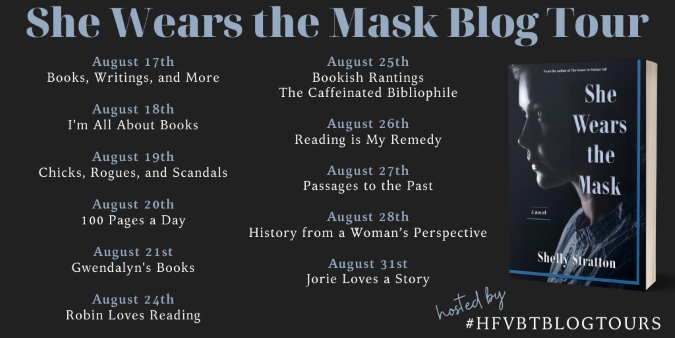
Blog Tour Schedule
Monday, August 17
Review at Books, Writings, and More
Tuesday, August 18
Feature at I'm All About Books
Wednesday, August 19
Interview at Chicks, Rogues, and Scandals
Thursday, August 20
Review at 100 Pages a Day
Friday, August 21
Review at Gwendalyn's Books
Monday, August 24
Review & Excerpt at Robin Loves Reading
Tuesday, August 25
Interview at Bookish Rantings
Excerpt at The Caffeinated Bibliophile
Wednesday, August 26
Feature at Reading is My Remedy
Thursday, August 27
Review at Passages to the Past
Friday, August 28
Guest Post at History from a Woman’s Perspective
Monday, August 31
Interview at Jorie Loves a Story
Giveaway
During the Blog Tour, we are giving away a $50 Amazon Gift Card! To enter, please use the Gleam form below. The giveaway is open to US residents only and ends on August 31st. You must be 18 or older to enter.She Wears the Mask
Comments
Post a Comment